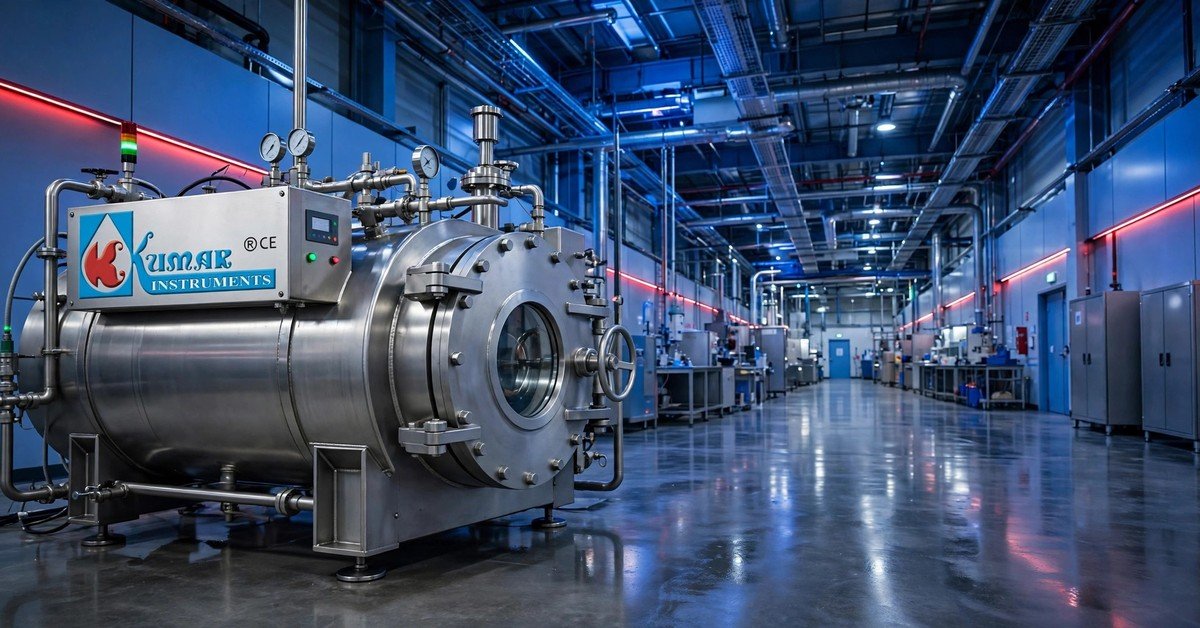
Autoclave Horizontal in Nadiad: When Your Lab Outgrows a Vertical Unit
Autoclave Horizontal in Nadiad: When Your Lab Outgrows a Vertical Unit
Every growing lab hits the same moment. The vertical autoclave that served faithfully for years is now running three cycles a day, loads are queuing up, and the technician is spending more time loading and unloading than doing actual lab work. The sterilization is fine. The capacity is not. That is usually when the conversation turns to the Autoclave Horizontal.
Horizontal autoclaves load from the front, take larger and bulkier loads, and move material through faster. For hospitals scaling up, pharma units adding lines, and educational institutes in a city like Nadiad running teaching plus research loads, the horizontal design solves problems a vertical unit simply cannot. But it is a bigger investment and a more complex machine, so the buying decision deserves more care. Here is how to think it through.
Vertical vs Horizontal: What Actually Changes
The core sterilization physics does not change: saturated steam under pressure, typically 121 degrees, for a validated exposure time. What changes is everything around it. A horizontal autoclave’s front-loading chamber (often with a sliding or hinged door) accepts trolleys, large trays, and bulky items that would never fit down a vertical unit’s top opening. Loading becomes a push-in operation instead of a lift-and-lower one, which matters enormously for heavy liquid loads.
Throughput is the real upgrade. Larger chamber volume per cycle, faster loading and unloading, and often the option of double-door (pass-through) configurations for cleanroom barriers. A hospital central sterile department or a pharma production support lab can process in one horizontal cycle what took three vertical cycles, with less operator strain.
The trade-off is footprint, utilities, and cost. Horizontal units need more floor space, often need three-phase power and a dedicated steam or water arrangement, and cost significantly more. The decision is economic as much as technical: does your sterilization volume justify it? If your vertical unit runs at capacity daily and the queue keeps growing, the answer is usually yes.
Sizing a Horizontal Unit: Think in Workflows, Not Litres
Catalogue chamber volumes tell you less than you think. What matters is your workflow: what goes in, in what containers, how it is arranged, and how often. A chamber that fits your largest single item with steam space around it, and handles your peak daily load in a comfortable number of cycles, is the right size.
Map it concretely. List your typical loads: media bottles (what size, how many per batch), instrument trays, waste bags, glassware. Note which loads cannot be mixed (waste and sterile media never share a cycle). Then count cycles per day at peak. If the answer is more than three or four on a vertical unit, a horizontal unit will likely cut that in half while improving load quality.
Do not forget the room. Horizontal autoclaves need clearance for the door swing or slide, trolley movement, ventilation, and service access on at least one side. Measure the installation site carefully, including the path the unit travels on delivery day. These are heavy machines, and “it does not fit through the corridor” is a discovery you want to make on paper.
Steam Supply and Utilities: The Hidden Part of the Purchase
Unlike small vertical units that generate their own steam electrically, larger horizontal autoclaves often need a dedicated steam supply or have substantial built-in steam generation with corresponding power and water demands. This is the part of the purchase that surprises buyers, so settle it early.
Clarify with the supplier exactly what the unit needs: electrical supply (single or three phase, what amperage), water quality and connection (treated water is usually required), drainage for condensate and exhaust, and ventilation for the heat the unit rejects into the room. Get these requirements in writing before ordering, and confirm your facility can provide them. The cost of upgrading electricals or water treatment after delivery can rival the price difference between models.
For labs in Nadiad’s educational and healthcare institutions, where facilities teams manage shared utilities, loop them in early. An autoclave that the building cannot support is not a bargain at any price.
Controls, Cycles, and Documentation
A horizontal autoclave serving a busy lab needs controls that match the workload: preset validated cycles for different load types (liquids, wrapped goods, waste, instruments), clear displays, and proper documentation of every cycle. In regulated environments, the cycle record is a compliance document, so printers or digital logging are not accessories. They are requirements.
Ask the supplier what cycles come pre-programmed and whether they can be customized and validated for your specific loads. Ask how cycle data is recorded and retrieved. Ask about the controller’s behaviour during power interruptions: a large horizontal unit mid-cycle during a dip must fail safe, and the operator must know exactly what happened and what to do next.
Validation support matters more at this scale. A horizontal autoclave in a hospital or pharma setting will face qualification protocols (installation, operational, and performance qualification). Ask what documentation the supplier provides to support this: chamber mapping data, calibration certificates, material certifications for the pressure vessel. A manufacturer experienced with regulated customers will have this ready. One who has not will look surprised by the question.
Safety at Scale: Bigger Vessel, Bigger Responsibility
Everything about autoclave safety scales up with a horizontal unit: larger pressure vessel, heavier door, more stored energy. The safety systems must scale accordingly, and your scrutiny should too.
Verify the pressure vessel certification and rating. Confirm the door interlock: it must physically prevent opening under pressure, and on sliding-door models the mechanism should be robust and clearly visible in operation. Confirm independent safety devices beyond the controller: safety valves, over-temperature cutoffs, and pressure relief, each testable and documented.
Operator training becomes more important at this scale. A vertical benchtop unit is forgiving of inexperience. A large horizontal autoclave is not. Factor training into the purchase: ask the supplier what operator training is included, and make sure everyone who will run the unit completes it. The best safety device is a trained operator who understands what the machine is doing.
Nadiad Considerations: Institutions, Hospitals, and Growth
Nadiad’s demand for horizontal autoclaves comes from its institutions. Educational campuses with teaching labs plus research facilities generate mixed loads at high volume: student glassware, research media, departmental waste. A horizontal unit with flexible cycles handles this mix far better than multiple vertical units, and centralizes the sterilization workflow.
Hospitals in the region face the same scaling logic. As surgical volumes grow, central sterile departments outgrow vertical units quickly. The move to horizontal is usually driven by instrument tray throughput, and the double-door option becomes relevant where clean and dirty sides must stay separated.
Service reach completes the picture. A horizontal autoclave is a critical-path machine: when it is down, sterilization stops. Confirm service presence for the Nadiad region, spare parts availability for the specific model (gaskets, valves, controller boards), and realistic response times. For a machine this central to operations, the service agreement matters as much as the specification sheet.
When should a lab switch from vertical to horizontal?
The usual triggers are: the vertical unit runs at capacity daily with queues forming, loads are too bulky for top-loading, operator strain from lifting heavy loads is becoming a safety concern, or workflow demands (like cleanroom pass-through) require front loading. If two or more apply, it is time to evaluate horizontal options seriously.
Do horizontal autoclaves need a separate steam boiler?
It depends on the model. Smaller horizontal units often have built-in electric steam generation, while larger ones may need an external steam supply. Always confirm the exact utility requirements (power, water, drainage, steam) with the supplier before ordering, and verify your facility can provide them.
What is a double-door (pass-through) autoclave?
A pass-through unit has doors on both ends and sits in a wall between two areas, typically a dirty side and a clean side. Loads enter dirty and exit clean without crossing back. This is standard in hospital sterile departments and pharma cleanrooms where contamination control requires physical separation.
How are horizontal autoclave cycles validated?
Through the standard qualification sequence: installation qualification (it is installed correctly), operational qualification (it operates to specification), and performance qualification (it sterilizes your actual loads, proven with biological indicators and thermometric mapping). The supplier should provide documentation supporting each stage.
What maintenance does a horizontal autoclave need?
Daily checks of gauges, gaskets, drains, and door mechanisms. Regular inspection of safety valves and seals. Scheduled preventive maintenance covering the steam system, controls, and pressure vessel integrity. And calibration of temperature and pressure instruments on a defined schedule. Keep logs of everything: at this scale, maintenance records are compliance records.
Moving to a Autoclave Horizontal is a step up in capacity, and with the right sizing, utilities, and supplier support, it transforms a lab’s sterilization workflow. For hospitals, institutions, and growing labs in Nadiad and across Gujarat, Kumar Instruments manufactures steam sterilizers engineered for dependable high-volume duty. Call us at Kumar Instruments, 54/5911 Sadar Thana Rd, Basti Harphool Singh, Sadar Bazar, New Delhi 110006, phone +91 98994 63478, and we will help you specify the right horizontal unit for your facility.