
Autoclave Vertical in Bathinda: Choosing the Right Sterilizer for Your Lab
Autoclave Vertical in Bathinda: Choosing the Right Sterilizer for Your Lab
Sterilization is the one lab process where “good enough” does not exist. A culture medium that is almost sterile grows contaminants. Surgical instruments that are nearly sterile are not sterile. The machine that stands between your lab and that failure is the autoclave, and for most laboratories the workhorse choice is the Autoclave Vertical: top-loading, compact, and built for the daily sterilization loads that keep a lab running.
Bathinda’s labs span hospitals, agricultural research stations, educational institutes, and testing facilities, and nearly all of them sterilize something every day. Yet vertical autoclaves are often bought on capacity and price alone, with little attention to the steam dynamics, safety systems, and build details that decide whether the unit sterilizes reliably for a decade or becomes a maintenance headache in year two. This guide covers what to evaluate before you buy.
How a Vertical Autoclave Works (and Why Design Matters)
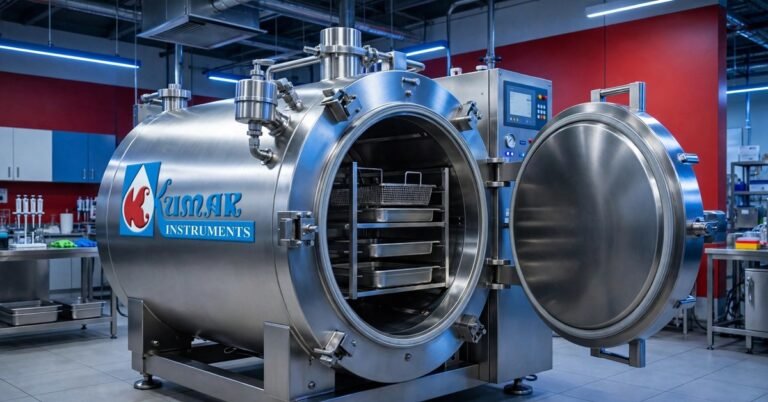
A vertical autoclave sterilizes with saturated steam under pressure, typically at 121 degrees Celsius. The vertical, top-loading design means the chamber is a deep cylinder: you lower baskets of media bottles, instruments, or waste loads down into it, seal the lid, and the cycle runs. Gravity helps here. Condensate drains naturally, steam rises through the load, and the footprint stays compact.
That simplicity is the vertical autoclave’s strength, but it also means the details matter more. Steam must reach every part of the load, air must be fully displaced (trapped air creates cold spots where sterilization fails), and the pressure vessel must contain it all safely. A well-designed unit handles these physics gracefully. A poor one leaves you with the worst possible outcome: a cycle that completes, a gauge that reads correctly, and a load that is not actually sterile.
For buyers, the lesson is that an autoclave is a pressure vessel first and a lab instrument second. Build quality, safety systems, and steam dynamics outweigh convenience features by a wide margin.
Capacity and Loading: Sizing for Real Workflows
Vertical autoclaves come in a range of chamber sizes, and the right choice follows your daily load, not your aspirations. Count what you actually sterilize: how many media bottles per batch, what volume of liquid, how often you run. Then consider the loading pattern. Liquids need headspace and careful arrangement to avoid boil-over. Wrapped instrument packs need steam penetration space. Waste loads are bulky but forgiving.
The classic mistake is buying too small and then overloading. An overfilled autoclave cannot circulate steam properly, and dense packing creates exactly the cold spots that cause sterilization failures. It is far better to run a properly loaded smaller unit twice than to cram everything into one overloaded cycle and hope.
Also think about handling. Top-loading means lifting loads down into the chamber, which gets heavy with liquid media. Check the working height: can your staff load and unload safely and comfortably? Some labs prefer a slightly smaller chamber they can load easily over a larger one that becomes an ergonomic strain. And confirm the baskets and accessories included. A chamber without proper loading baskets is an incomplete purchase.
Steam Dynamics: Air Removal and Penetration
This is the technical heart of autoclave performance, and the part buyers understand least. Steam sterilizes only where it reaches, and air trapped in the chamber or inside the load blocks steam completely. A pocket of trapped air stays cool while the gauge reads 121 degrees, and whatever sits in that pocket survives.
Good vertical autoclaves address this through design: steam inlet positioning that sweeps air out, a proper exhaust and drain system, and cycles that include air-removal phases. Ask the supplier how the unit handles air removal and whether the cycle is validated for the load types you run. For liquid loads, which are the hardest to sterilize reliably, this question is critical.
Validation is the word that separates serious equipment from the rest. Ask whether the autoclave’s performance has been tested with biological indicators or thermometric mapping, and whether the supplier can provide guidance on validating your specific loads. In hospital and pharma-adjacent labs around Bathinda, this documentation is not optional. It is what proves the sterilizer works.
Safety Systems: Non-Negotiable in a Pressure Vessel
An autoclave is a pressure vessel operating at temperatures that cause severe burns, and its safety systems deserve your closest scrutiny. Never compromise here, and never buy a unit where safety features are vague.
The essentials: a pressure gauge you can read clearly, a safety valve that releases at a set pressure independent of the controller, and a lid locking mechanism that physically prevents opening under pressure. Ask how the lid lock works: it should be a mechanical interlock, not just a warning light. Ask about the safety valve’s rating and whether it is tested. Ask what happens if the controller fails: there should be an independent over-temperature or over-pressure cutoff.
Then the operational safeties. The unit should not allow the cycle to start unless the lid is properly sealed. It should vent steam in a controlled manner at cycle end, not blast it. And the exterior should stay safe to approach during operation. Walk through a full cycle mentally with the supplier and ask what protects the operator at each step. The quality of the answers tells you everything about the manufacturer.
Bathinda Realities: Hospitals, Agriculture, and Water
Bathinda’s sterilization needs follow its institutions. Hospitals and clinical labs run instrument sterilization where failure has direct patient consequences, so validation documentation and reliable cycles are paramount. Agricultural research stations sterilize media and soil samples where the loads are bulky and frequent. Educational institutes need units that survive student use, which is harder duty than it sounds.
Water quality deserves special attention. Autoclaves need clean feed water, and hard or mineral-heavy water scales the chamber, clogs valves, and shortens element life. Bathinda’s groundwater varies, so ask the supplier about water requirements and whether you need treated water. A unit run on unsuitable water will show the damage within a year, and warranty rarely covers it.
Power stability matters as well. An autoclave mid-cycle during a voltage dip needs to behave safely: the controller should handle the interruption without dangerous states, and the cycle should either resume properly or abort clearly. Ask exactly what happens. “It just continues” is not a reassuring answer unless the supplier can explain how.
What to Confirm Before Ordering
Take these questions to every supplier. The thoroughness of the answers is itself a selection criterion.
Ask for the chamber’s working pressure and temperature ratings, and the safety margins built in. Ask how air removal is handled and whether load validation guidance is available. Ask for the safety systems in detail: lid interlock mechanism, safety valve rating, independent cutoffs. Ask about water quality requirements and what happens with hard water. Ask about the warranty, what it covers (gaskets and seals are wear items, so know their terms), spare parts availability, and service response in the Bathinda region. Ask for reference installations in labs similar to yours.
And remember the lifetime view. An autoclave that sterilizes reliably for fifteen years with basic maintenance is inexpensive at any reasonable price. One that needs constant attention, or worse, one whose sterilization you cannot trust, is expensive at any price.
What is the difference between a vertical and horizontal autoclave?
A vertical autoclave loads from the top into a cylindrical chamber and has a compact footprint, suiting most routine lab sterilization. A horizontal autoclave loads from the front (often with a sliding door) and suits larger or bulkier loads, higher throughput, and applications needing easier loading. For standard media, instrument, and waste loads, vertical units are the common choice.
What temperature and pressure does an autoclave use?
The standard sterilization condition is 121 degrees Celsius at the corresponding steam pressure, typically held for 15 to 20 minutes depending on the load. Some protocols use 134 degrees for shorter cycles. The key is not just reaching the setpoint but holding it uniformly throughout the load for the full exposure time.
How do I know my autoclave is actually sterilizing?
Use a combination of methods: the unit’s gauges and recorders for every cycle, chemical indicators in each load as a routine check, and periodic biological indicators (spore tests) as the definitive proof. If biological indicators ever fail, stop using the unit for critical loads until the cause is found and corrected.
Can I sterilize liquids in a vertical autoclave?
Yes, with care. Liquids need headspace in their containers, careful arrangement to prevent boil-over, and slower exhaust at cycle end to avoid violent boiling when pressure releases. Follow validated liquid cycles rather than improvising, and never fill containers to the brim.
How often should an autoclave be serviced?
Daily: check gauges, gaskets, and drain function. Regularly: inspect the safety valve, lid gasket, and seals for wear. Annually at minimum: a full service including safety system checks and calibration verification. Keep a log. In clinical and regulated labs, that log is a compliance requirement, not a suggestion.
A trustworthy Autoclave Vertical is the quiet foundation of every safe lab. For hospitals, research stations, and testing labs in Bathinda and across Punjab, Kumar Instruments manufactures steam sterilizers built for reliable daily duty. Get in touch at Kumar Instruments, 54/5911 Sadar Thana Rd, Basti Harphool Singh, Sadar Bazar, New Delhi 110006, phone +91 98994 63478, and we will help you choose the right sterilizer for your workload.