Laboratory Hot Plate in Jalandhar: Round or Rectangular, and What Else Matters
Laboratory Hot Plate in Jalandhar: Round or Rectangular, and What Else Matters
Every laboratory has one piece of equipment used so routinely that nobody thinks about it until it breaks. In many labs that piece is the hot plate. Heating a beaker of solution, keeping a water bath at temperature, evaporating a solvent gently, warming reagents before a reaction: the list of small daily heating jobs is endless. A Laboratory Hot Plate handles all of them, and for labs across Jalandhar, from sports goods testing to leather processing to small chemical units, it is one of the first instruments on the bench.
Buyers often treat the hot plate as a commodity to pick quickly and cheaply. That is a mistake, because a bad hot plate wastes time in small ways every day: uneven heating that ruins an evaporation, a control knob with no real precision, a surface that corrodes within a year. The purchase deserves more thought than it usually gets. And the first question, the one in the title, is as good a place to start as any.
Round or Rectangular: Does the Shape Matter?
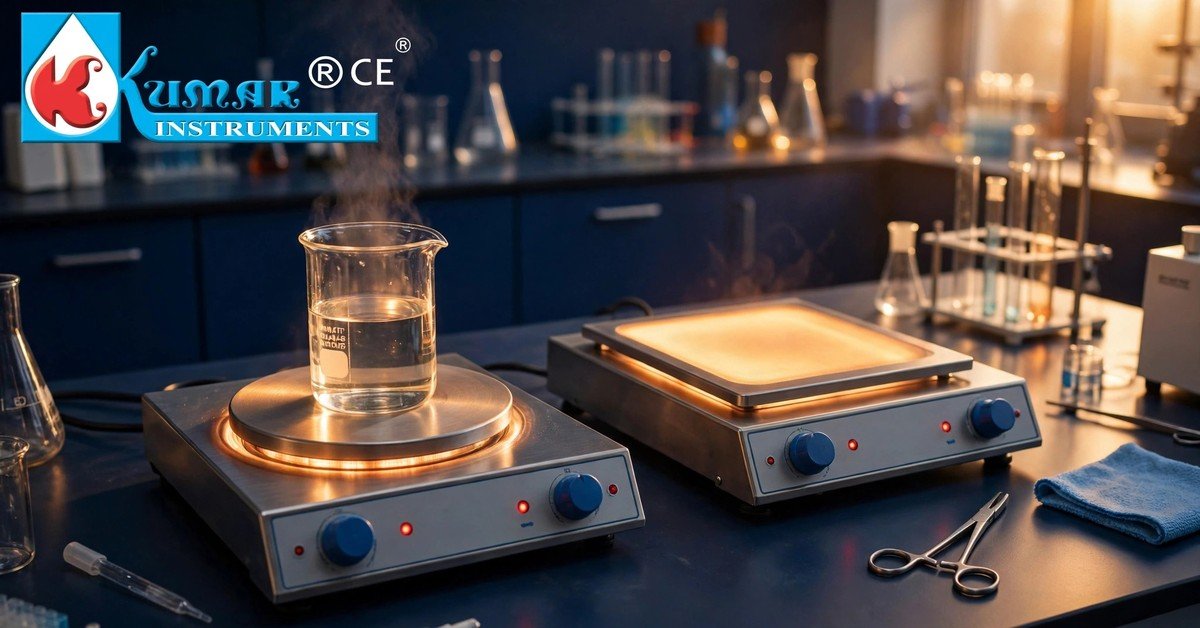
Yes, but not for the reason people expect. Shape matters mainly because of what sits on it. Round hot plates suit round vessels: beakers, flasks, and bottles, the most common shapes in a general laboratory. The circular heating zone matches the vessel base well, giving even contact and efficient heat transfer.
Rectangular hot plates suit different work. If the lab heats large flat-bottomed vessels, several small vessels side by side, or uses the plate as a warming surface for trays, the rectangular format gives more usable area in a footprint that fits a bench neatly. In industrial QC settings they get used for jobs a round plate cannot handle, like warming several sample containers at once.
The honest answer is to match the shape to the vessels already in the lab. If it is beakers and flasks, round is the natural fit; if it is batches of containers or flat trays, rectangular earns its place. Either way, the more important specifications are the ones buyers often skip: temperature range, control precision, and heating uniformity. A well-controlled plate of either shape beats a sloppy one of the ideal shape.
What the Hot Plate Does All Day
The core job is controlled heating of vessels and contents: dissolving solids into solvents, maintaining a reaction at set temperature, evaporating liquids gently, heating water and oil baths, warming samples before analysis. The hot plate replaces the open flame for most of these, which matters for safety as much as convenience, since many labs handle flammable solvents where a flame is simply not acceptable.
In Jalandhar’s industrial context the applications get specific. Sports goods manufacturing involves adhesives, coatings, and rubber compounds whose QC includes heating and curing tests. Leather goods processing uses chemicals, dyes, and finishing agents needing controlled heating during testing and formulation. Hand tool and light engineering units run small materials and chemical testing setups. Educational institutions use hot plates in chemistry teaching labs. Each is a small heating job, repeated daily, where reliability matters more than sophistication.
Many hot plates also include magnetic stirring, combining heating and mixing in one unit. For solution preparation and reactions needing continuous agitation, a stirrer hot plate is genuinely useful and saves bench space. But be honest about whether the stirring function is needed: it adds cost and complexity, and a lab that only heats water baths pays for a feature it will never switch on. Buy the capability the workload needs.
Temperature Control and Heating Uniformity
The control system separates a good hot plate from a frustrating one. Basic models use a simple thermostat that cycles the heater on and off, producing temperature that swings around the setpoint. Better models use electronic control with feedback from a sensor, holding surface temperature far more steadily. For work where exact temperature matters, such as controlled evaporations, the difference is not subtle.
Heating uniformity across the surface rarely appears in brochures but shows up immediately in use. A plate with hot spots boils a solution violently at one point while barely warming it at another. This matters most with large vessels covering much of the surface, and in evaporations where uniform gentle heat gives clean results and hot spots cause bumping and splattering. Ask the supplier about uniformity, and see the plate running before committing if possible.
External temperature probes are worth knowing about. Some plates accept a probe that goes into the liquid, so the controller regulates actual sample temperature rather than plate surface temperature. For precise work this is a significant upgrade, because plate surface and vessel contents are never quite at the same temperature. Labs doing method-driven QC should consider this option seriously.
Safety and Build: What Survives Lab Life
A hot plate is a burn hazard by definition, and safety features keep a routine instrument from causing routine injury. The most basic is a clear hot-surface indicator: a warning light that stays on while the plate is hot, even after switch-off. Plates retain heat for a long time, and most lab burns happen when someone touches a plate that looks off but is still dangerously hot. An indicator light is cheap insurance.
Over-temperature protection matters too. If the control system fails, a good plate has an independent safety cutout preventing runaway heating, especially important where plates run unattended. Spill protection is the third consideration: liquids will spill sooner or later, and the design should keep them away from electronics. A sealed or well-shrouded top lasts far longer in real lab conditions. Check bench stability as well: a plate holding a tall flask of hot liquid must not wobble when bumped.
The top plate material decides how the unit ages. Common options include coated metals, ceramic, and aluminium alloys, each with trade-offs in chemical resistance and durability. Ask what the top is made of and what it resists rather than discovering the answer through corrosion. The casing and controls should suit the environment too: operable with gloved hands, readable at a glance, and sealed against dust. In Jalandhar’s industrial areas, where workshops and labs share dusty air, clogged vents and jammed controls are not theoretical concerns.
Buying Smart: Matching the Plate to the Workload
Start from the work, not the catalogue. List what the lab heats, in what vessels, at what temperatures, and how often. A teaching lab heating water baths needs a different plate than a QC lab running controlled solvent evaporations. Write the list down and buy against it. This prevents underbuying, which leaves the lab struggling, and overbuying, which ties up budget in unused features.
Consider how many plates the lab needs. One large plate cannot do two jobs at two temperatures simultaneously, and two modest plates often serve better than one premium one. For Jalandhar’s small industrial labs and educational institutions, where budgets are real constraints, this is practical advice: distribute heating capacity across the bench rather than concentrating it in a single showcase unit.
Finally, buy from a supplier who will still be reachable when service is needed. Heating elements wear out, controllers fail, top plates get damaged: normal events in a hardworking instrument’s life, and repairs are usually inexpensive. What matters is whether spares and service are available domestically and quickly. An established Indian manufacturer with a service network turns a breakdown into a brief interruption; anything else turns it into a saga. Confirm power rating and supply compatibility too, a five-minute check that prevents tripped breakers and underperforming heaters.
Frequently Asked Questions
Should we buy a round or rectangular hot plate?
Match the shape to your vessels. Round plates suit beakers, flasks, and bottles, which dominate most general laboratories, giving good contact across the vessel base. Rectangular plates suit flat-bottomed vessels, multiple small containers heated side by side, or tray warming, and fit bench space efficiently. More important than shape are temperature control quality and heating uniformity, so evaluate those regardless of format.
Do we need a hot plate with a magnetic stirrer?
Only if your work needs simultaneous heating and mixing, such as solution preparation or reactions requiring continuous agitation. A stirrer hot plate saves bench space and is genuinely useful for that workload. But if the lab only heats water baths, evaporates solvents, or warms vessels, stirring adds cost without benefit. Be honest about the actual workload before paying for the combination.
How important is temperature control precision?
It depends on the work. For general warming and water baths, basic control is adequate. For controlled evaporations, temperature-sensitive reactions, or method-driven QC, electronic control with feedback holds temperature far more steadily than a simple thermostat, and the difference shows in results. If precision matters, consider models accepting an external probe to control actual sample temperature rather than plate surface temperature.
What safety features should we insist on?
A hot-surface warning indicator that stays lit while the plate is hot, even after switch-off, is essential since retained heat causes most burns. Independent over-temperature protection guards against control failure during unattended operation. Spill-resistant design keeps liquids away from electronics, and a stable solid base prevents tipping. Check all of these before buying, not after the first incident.
How long should a laboratory hot plate last?
A well-built plate used within its ratings can serve for many years, though heating elements and controllers wear with heavy use. Longevity depends on build quality, the top material’s resistance to your lab’s chemicals, and sensible use within rated temperatures. Keep the supplier relationship active so that when a part eventually needs replacement, spares and service are available quickly and domestically.
For laboratories and industrial QC setups in Jalandhar needing dependable everyday heating, the Laboratory Hot Plate from Kumar Instruments, 54/5911 Sadar Thana Rd, Basti Harphool Singh, Sadar Bazar, New Delhi 110006, phone +91 98994 63478, is built for the daily grind of real lab work. Describe your heating workload to their team and they will help you pick the right size, shape, and control level for your bench.