L.O.D Oven in Jamnagar: A Practical Buyer’s Guide for Pharma and Chemical Labs
L.O.D Oven in Jamnagar: A Practical Buyer’s Guide for Pharma and Chemical Labs
In a pharmaceutical QC lab, few numbers carry as much weight as moisture content. A raw material batch that reads half a percent too wet can fail specification, hold up production, and trigger a round of retesting nobody has time for. The machine behind that number is usually the most taken-for-granted box in the lab: the L.O.D Oven. It dries the sample, you weigh the loss, and the result decides whether the batch moves forward or goes back.
Jamnagar’s labs know this routine well. Between the pharmaceutical units, chemical processors, and refinery-adjacent industries around the city, loss-on-drying testing runs daily in dozens of QC departments. Yet when it comes time to buy an L.O.D oven, many purchase decisions are made on price alone, and the consequences show up months later as drifting results and repeat tests. This guide covers what experienced QC heads in Jamnagar actually evaluate before signing off on a purchase.
What an L.O.D Oven Does (and Why Moisture Matters So Much)
Loss on drying is exactly what it sounds like. You weigh a sample, heat it in the oven until the moisture (and other volatiles) drive off, weigh it again, and the difference is your L.O.D value. Pharmacopeial methods specify the temperature and time precisely, which means the oven’s job is to deliver exactly that temperature, evenly, every single time.
Moisture content affects nearly everything downstream. In active pharma ingredients, excess moisture can mean degradation, clumping, or failed stability. In finished formulations, it affects tablet hardness, dissolution, and shelf life. In chemicals, it changes assay values. The L.O.D oven sits upstream of all these decisions, which is why QC managers treat it as a critical instrument even though it looks like a simple heated box.
The key insight for buyers: an L.O.D oven is not a general drying oven doing casual work. It is a measurement instrument. The drying step is part of an analytical method, and the oven’s temperature accuracy directly becomes the result’s accuracy. Buy it with the same seriousness you would buy a balance or a pH meter.
Temperature Control: Precision Where It Counts
Pharmacopeial L.O.D methods typically call for 105 degrees Celsius, and the tolerance is tighter than most buyers realize. A few degrees of overshoot can drive off more than moisture, while undershoot leaves moisture behind. Either way, the result is wrong, and the error is invisible. The sample looks dry. The number looks plausible. Only a cross-check reveals the problem.
This is why the controller matters more than the heating element. Look for a digital PID controller with a clear, readable display, not a basic thermostat with a dial. A good controller holds the set temperature with minimal swing and recovers quickly after the door is opened. Ask the supplier about temperature stability (how much the temperature varies at the setpoint over time) and uniformity (how much it varies between different points in the chamber). Both should be tight, and both should be verified with the chamber loaded, not empty.
Calibration access is the other half of the story. The oven should have a straightforward way to verify chamber temperature against a calibrated reference thermometer, ideally through a dedicated port so you are not threading wires through the door seal. Labs in Jamnagar facing pharma audits need this. An auditor who cannot see a calibration trail will not accept the L.O.D numbers, however good they look.
Chamber Design and Airflow: The Details That Decide Uniformity
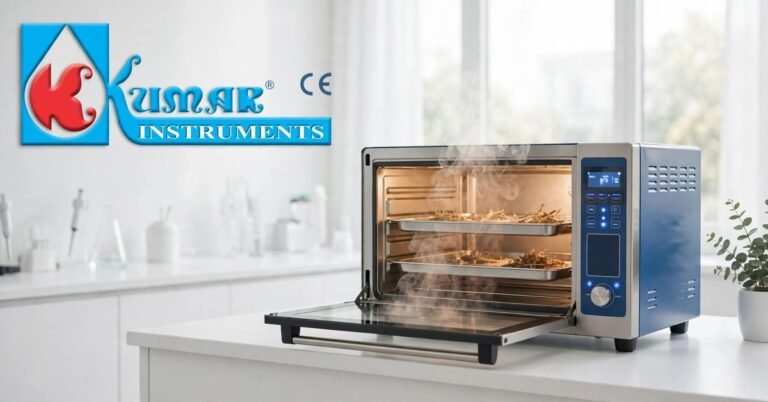
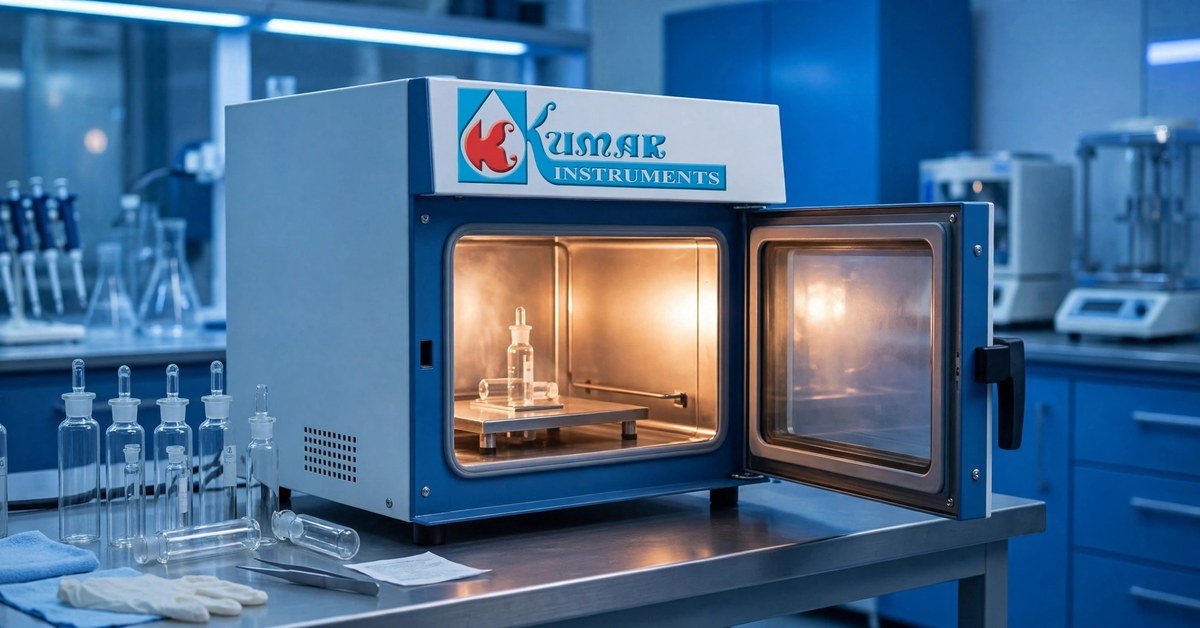
Open the door of a well-designed L.O.D oven and you will notice the details: smooth stainless steel walls with rounded corners, shelves that slide firmly without wobbling, and air vents positioned to move heat evenly. Open a poor one and you will see sharp corners that trap residue, thin shelves that sag under load, and hot spots you can feel with your hand.
Forced air circulation (a fan moving heated air through the chamber) gives far better uniformity than gravity convection, especially when the oven is loaded with multiple samples. In a busy pharma QC lab in Jamnagar running dozens of L.O.D samples a day, the oven is rarely empty, so empty-chamber uniformity figures are meaningless. Ask how the unit performs fully loaded, and if possible, see it demonstrated that way.
Chamber material deserves attention too. Stainless steel interiors resist corrosion from chemical vapours and clean up easily after spills. In Jamnagar’s humid coastal air, a painted mild-steel interior will eventually show rust, starting at the corners and welds. It does not affect results on day one, but it shortens the machine’s hygienic life considerably.
Sizing the Oven for Pharma QC Workloads
L.O.D ovens come in a range of chamber sizes, and the right choice depends on your daily sample throughput and the size of your drying dishes. The common mistake is buying too small and then cramming dishes together, which blocks airflow and creates exactly the uneven drying you bought the oven to avoid.
Work it out practically. Count the maximum number of samples you dry in a single batch, check the dish or bottle dimensions, and make sure each has air space around it. Then consider your batch frequency. A lab running three L.O.D batches a day needs either a larger chamber or faster turnaround, and turnaround depends on heat-up and cool-down times as much as on size.
Also plan for the oven’s footprint and utilities. L.O.D ovens need a stable bench or floor position away from drafts, with clearance for ventilation. Check the power requirement against your lab’s supply. Most laboratory ovens run on standard single-phase power, but larger units may need more, and discovering this on installation day is an avoidable headache.
Jamnagar Realities: Industrial Air, Humidity, and Service Access
Equipment lives a harder life in Jamnagar than the brochure assumes. Three local factors should shape your buying decision.
First, the industrial atmosphere. With refinery and chemical operations in the region, airborne contaminants and humidity are part of daily life. The oven’s exterior finish and electrical compartments should be well sealed. Stainless interiors are not optional here. They are what keeps the chamber hygienic year after year.
Second, power quality. Voltage fluctuations are common in industrial belts, and an L.O.D oven’s controller is sensitive to them. A dip at the wrong moment can reset the controller mid-cycle, ruining a batch of samples and the hours invested in them. Ask whether the unit tolerates normal voltage variation and whether it resumes automatically after an outage. If your area sees frequent dips, budget for a stabilizer as part of the purchase, not as an afterthought.
Third, service reach. An L.O.D oven is a daily-use instrument in pharma QC, and downtime directly hits batch release. Before buying, confirm who services the unit in the Jamnagar region, what the response time looks like, and whether critical spares (controllers, heating elements, gaskets) are stocked within reasonable distance. A slightly cheaper oven with no local service backup is the most expensive option of all.
What to Verify Before You Place the Order
Narrow your shortlist, then verify these points with each supplier. The answers separate serious manufacturers from box-shifters.
Ask for temperature uniformity and stability figures measured with a loaded chamber. Ask how the controller behaves during a power dip and after an outage. Ask about the calibration procedure and whether a calibration certificate is provided with the unit. Ask for the warranty terms in plain words, including what happens if the controller or heating element fails in year two. Ask how long spare parts will be available, because an L.O.D oven should serve for a decade or more. And ask for reference installations in pharma or chemical QC labs that you can contact.
Finally, total up the real cost. Purchase price is only the first line. Add expected electricity consumption over the machine’s life, calibration costs, and the cost of even one ruined batch of samples. On that math, the better-built oven almost always wins.
What temperature does an L.O.D oven operate at?
Most pharmacopeial loss-on-drying methods specify 105 degrees Celsius, though some materials use different temperatures per their monographs. The oven must hold the set temperature steadily and uniformly, since even small deviations change how much moisture is driven off. Always follow the temperature given in your specific test method.
How is an L.O.D oven different from a regular laboratory oven?
A regular lab oven is a general-purpose dryer, while an L.O.D oven is used as part of an analytical measurement. That means tighter demands on temperature accuracy, uniformity, and calibration traceability. In pharma QC, the drying step directly becomes a reported result, so the oven is treated as a critical instrument with documented performance.
Can one oven handle both L.O.D and general drying work?
Technically yes, but in a regulated QC lab it is better to dedicate the L.O.D oven to analytical work. General drying (glassware, for instance) introduces contamination risk and wear that can compromise the controlled conditions L.O.D testing needs. If workload forces sharing, keep strict cleaning and scheduling discipline between the two uses.
How often should an L.O.D oven be calibrated?
Most pharma QC labs verify chamber temperature quarterly against a calibrated reference and perform full calibration annually, or after any move, repair, or controller replacement. Maintain a log of daily temperature checks. Auditors expect to see it, and a logged drift caught early is a five-minute correction instead of a deviation report.
What causes inconsistent L.O.D results between batches?
The usual suspects are uneven chamber temperature, overloading that blocks airflow, door openings during the cycle, and an uncalibrated controller. Less obvious causes include changes in ambient conditions and worn door gaskets leaking heat. When results drift, check the oven’s performance first before questioning the method or the analyst.
A reliable L.O.D Oven pays for itself in consistent results, fewer retests, and audit-ready documentation. For pharma and chemical labs in Jamnagar and across Gujarat, Kumar Instruments manufactures laboratory ovens built for the precision that QC work demands. Talk to us at Kumar Instruments, 54/5911 Sadar Thana Rd, Basti Harphool Singh, Sadar Bazar, New Delhi 110006, phone +91 98994 63478, and we will help you select the right oven for your laboratory.